What is Sukkot?
Fall Feasts . God's Calendar and Biblical Feasts . Holidays . Torah/Bible
Sukkot, What is that?
I have been asked this question many times. I usually say, it is a Biblical feast that God commanded His people to do, and is sometimes called the Feast of Booths.
But, I thought I would share a little more about Sukkot for anyone out there that just isn’t sure what it is, and would maybe like to learn more, or even try celebrating it.
-
First, Sukkot is one of the three feasts God command’s that all the men of Israel travel to Israel to make a harvest offering at the temple. Here is the passage in Deuteronomy 16:13-17
” Celebrate the Festival of Tabernacles for seven days after you have gathered the produce of your threshing floor and your winepress. 14 Be joyful at your festival—you, your sons and daughters, your male and female servants, and the Levites, the foreigners, the fatherless and the widows who live in your towns. 15 For seven days celebrate the festival to the Lord your God at the place the Lord will choose. For the Lord your God will bless you in all your harvest and in all the work of your hands, and your joy will be complete.
“Three times a year all your men must appear before the Lord your God at the place he will choose: at the Festival of Unleavened Bread, the Festival of Weeks and the Festival of Tabernacles. No one should appear before the Lord empty-handed: 17 Each of you must bring a gift in proportion to the way the Lord your God has blessed you.”
There is no temple to Yehovah in Israel at this time, so no one can actually take an offering/sacrifice to the temple. But, from this passage we see that Sukkot is one of three harvest festivals to Yehovah. It is a celebration like Thanksgiving in America. A time to praise God for all His blessings for the crops reaped.
-
Second, Sukkot, is a memorial feast. We are command to remember the time when the Israelites had to live in the wilderness for 40 years because of their lack of faith and obedience. Leviticus 23:33-44 tells us this.
” The Lord said to Moses, 34 “Say to the Israelites: ‘On the fifteenth day of the seventh month the Lord’s Festival of Tabernacles begins, and it lasts for seven days. 35 The first day is a sacred assembly; do no regular work. 36 For seven days present food offerings to the Lord, and on the eighth day hold a sacred assembly and present a food offering to the Lord. It is the closing special assembly; do no regular work.
37 (“‘These are the Lord’s appointed festivals, which you are to proclaim as sacred assemblies for bringing food offerings to the Lord—the burnt offerings and grain offerings, sacrifices and drink offerings required for each day. 38 These offerings are in addition to those for the Lord’s Sabbaths and in addition to your gifts and whatever you have vowed and all the freewill offerings you give to the Lord.)
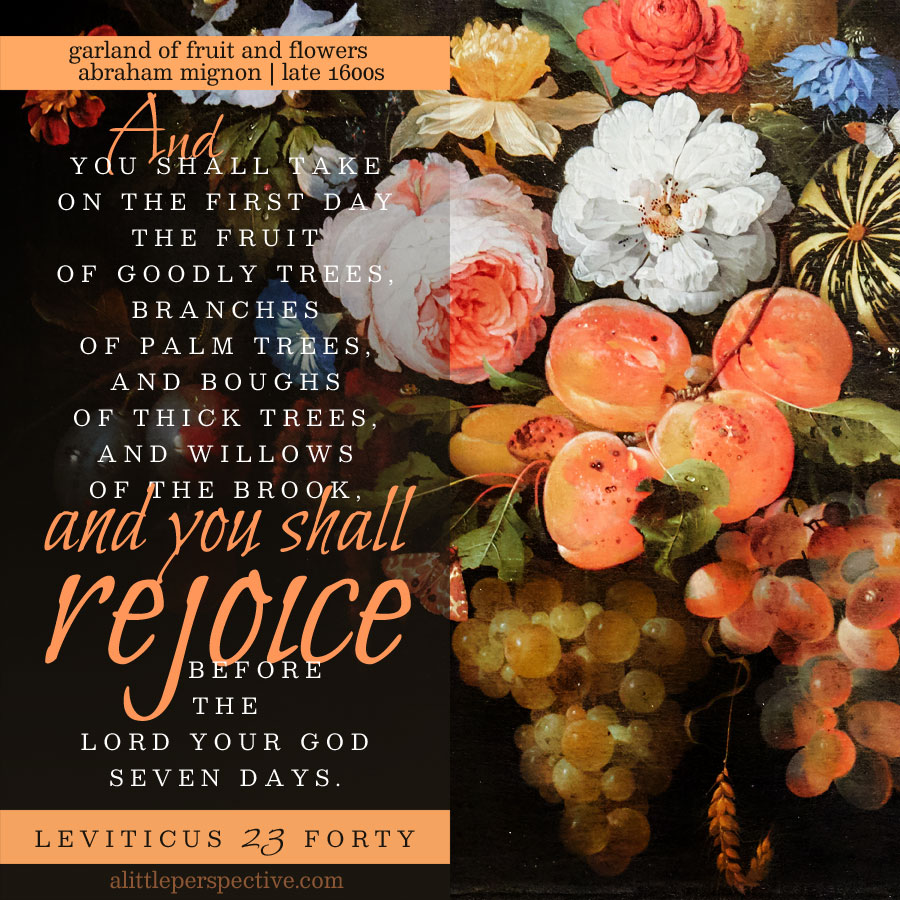
39 “‘So beginning with the fifteenth day of the seventh month, after you have gathered the crops of the land, celebrate the festival to the Lord for seven days; the first day is a day of sabbath rest, and the eighth day also is a day of sabbath rest. 40 On the first day you are to take branches from luxuriant trees—from palms, willows and other leafy trees—and rejoice before the Lord your God for seven days. 41 Celebrate this as a festival to the Lord for seven days each year. This is to be a lasting ordinance for the generations to come; celebrate it in the seventh month. 42 Live in temporary shelters for seven days: All native-born Israelites are to live in such shelters 43 so your descendants will know that I had the Israelites live in temporary shelters when I brought them out of Egypt. I am the Lord your God.”
44 So Moses announced to the Israelites the appointed festivals of the Lord.”
-
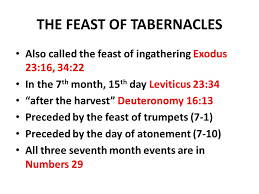
Third, we are told to celebrate this feast for seven days, and then to add on a eight day of celebrating. Numbers 29:35-38
-
Fourth, we are to set aside the first day and the eighth day as a Sabbath. A Sabbath is a day in which we are to stop our regular work and set aside the day and make it special.
-
Fifth, The first day and the eighth day of Sukkot are days we are to have a feast and a gathering of other believers to declare God’s blessings and goodness to one another.
-
Sixth, we are to decorate with branches and leaves a Sukkah (temporary dwelling place). This is commanded to all the natives of Israel. It isn’t expected to actual build a sukkah outside of Israel, but people like to do it for fun and as a reminder.
-
Lastly, I believe we are to give to others at the time of Sukkot. All those offerings that were brought to the priest are to bless the people, specifically, the poor, foreigner, needy, and those that serve in the temple.
The feast of Sukkot is called Sukkot, the feast of Ingathering, Harvest Festival, or First Fruits (it is the third of three first fruits festivals annually.)
It is a fun week of celebrating God’s goodness.
I believe if we were in the Promised Land ,we would all be harvesting and preserving our produce on days 2-7 of the feast, minus the weekly Sabbath. But, we are not in the promised land, so instead as we wait for the return of our Messiah, we celebrate His feast days as a reminder of what He has done, what He is doing, and what He will do.
Chag Samaech. Happy Feast!
Related Posts:




Leave a Reply