Today, I was thinking about how people say things like…
“We grew a part.” “He changed.” “I’m not the person I was when we met.”
Often people use these lines when talking about their divorce, break up, or the dissolving of a friendship. But, it doesn’t make sense to me. Of course, you have changed, and hopefully, your spouse, friends, and family are also changing.
We should grow and change everyday. One of my favorite pictures in creation is the butterfly. It is such a beautiful image of growth and change through the struggle of hard work and the elements of life. The process of change from an egg to a butterfly is called Metamorphosis.
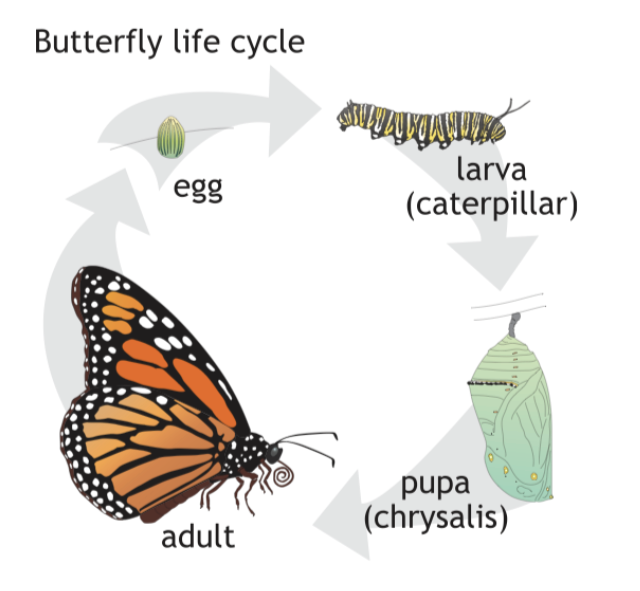
Butterflies undergo a complete metamorphosis, which means there are four separate stages in the life cycle (egg, larva, pupa, and adult). Each stage looks completely different and is necessary for the growth and final development of the butterfly.
Egg Stage: Female butterflies look for specific plants, called host plants, on which to lay eggs. A butterfly usually lays 200-500 eggs which vary in shape and size depending on the species. Most species hatch in four to five days, while others may take as long as three weeks.
Larva Stage: When the eggs hatch, tiny caterpillars begin feeding and growing. Its first meal is usually the eggshell, which provides it with important nutrients. Then it will begin eating the host plant. Almost all caterpillars eat leaves but some eat stems, roots, fruits, seeds, seed pods or flowers. They will eat only the host plant and will not move to any adjacent plant of a different species – even if it runs out of food. As they eat and their bodies expand, their skin (an exoskeleton with a limited stretching capacity) becomes tight and eventually splits and sheds, revealing new skin beneath. This is called molting and occurs several times as the larva grows.
Pupa Stage: When the caterpillar has grown enough, it finds a protected spot, molts for the last time, and forms an encasement in which they metamorphose. Most butterfly caterpillars form a chrysalis. The pupa undergoes tremendous change. The caterpillar releases digestive juices that break down most of its body into a “tissue cell soup” from which it develops four wings, new legs, new eyes, new mouthparts, and genitalia. When the insect emerges, its metamorphosis is complete.
Adult Stage: The fully developed adult splits the pupal case open, crawls out and hangs upside down to facilitate stretching and drying its wings. Its wings are inflated by pumping fluid into the wing veins. At this stage, the wings are very soft and wet and the butterfly/moth must remain suspended while waiting up to two hours for its wings to dry. Once the wings are stretched and dried, the adult flies off to feed, find a mate and begin the cycle again. The average adult lifespan is two weeks but ranges from several days to as long as 11 months.
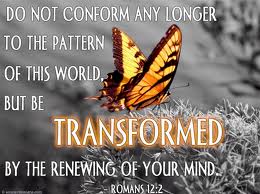
I once heard a sermon on the verse Romans 12:2, and the preacher said that the word “transformed” was in Greek μεταμορφοῦσθε(metamorphousthe). The preacher then gave a beautiful story of the life of a butterfly as it grew from egg to butterfly and weathered storms and struggled through each stage.
I don’t remember the place or the preacher, but that sermon has stuck with me since I was a little girl.
As I was pondering these things today, I decided to go look for the context of this Bible verse.
Check it out.
Romans 12
(A section of a letter written by the Apostle Paul to the church in Rome on how they should live during such troubling times)
“Therefore, I urge you, brothers and sisters, in view of God’s mercy, to offer your bodies as a living sacrifice,
holy and pleasing to God—this is your true and proper worship.
Do not be conform to the pattern of this world, but be transformed by the renewing of your mind.
Then you will be able to test and approve what God’s will is—his good, pleasing and perfect will.
For by the grace given me I say to every one of you:
Do not think of yourself more highly than you ought, but rather think of yourself with sober judgment,
in accordance with the faith God has distributed to each of you.
For just as each of us has one body with many members,
and these members do not all have the same function,
so in Christ we, though many, form one body, and each member belongs to all the others.
We have different gifts, according to the grace given to each of us.
If your gift is prophesying, then prophesy in accordance with your faith;
if it is serving, then serve; if it is teaching, then teach;
if it is to encourage, then give encouragement; if it is giving, then give generously;
if it is to lead, do it diligently; if it is to show mercy, do it cheerfully.
Love must be sincere. Hate what is evil; cling to what is good.
Be devoted to one another in love. Honor one another above yourselves.
Never be lacking in zeal, but keep your spiritual fervor, serving the Lord.
Be joyful in hope, patient in affliction, faithful in prayer.
Share with the Lord’s people who are in need. Practice hospitality.
Bless those who persecute you; bless and do not curse.
Rejoice with those who rejoice; mourn with those who mourn.
Live in harmony with one another.
Do not be proud, but be willing to associate with people of low position. Do not be conceited.
Do not repay anyone evil for evil. Be careful to do what is right in the eyes of everyone.
If it is possible, as far as it depends on you, live at peace with everyone.
Do not take revenge, my dear friends, but leave room for God’s wrath, for it is written:
“It is mine to avenge; I will repay,” says the Lord.
On the contrary:
“If your enemy is hungry, feed him;
if he is thirsty, give him something to drink.
In doing this, you will heap burning coals on his head.”
Do not be overcome by evil, but overcome evil with good.”
I couldn’t have received a better word from the Holy Spirit today. I love when a thought comes to mind that sends me to my Bible, and then God speaks a needed word to my heart.

 Pupa Stage: When the caterpillar has grown enough, it finds a protected spot, molts for the last time, and forms an encasement in which they metamorphose. Most butterfly caterpillars form a chrysalis. The pupa undergoes tremendous change. The caterpillar releases digestive juices that break down most of its body into a “tissue cell soup” from which it develops four wings, new legs, new eyes, new mouthparts, and genitalia. When the insect emerges, its metamorphosis is complete.






Leave a Reply